

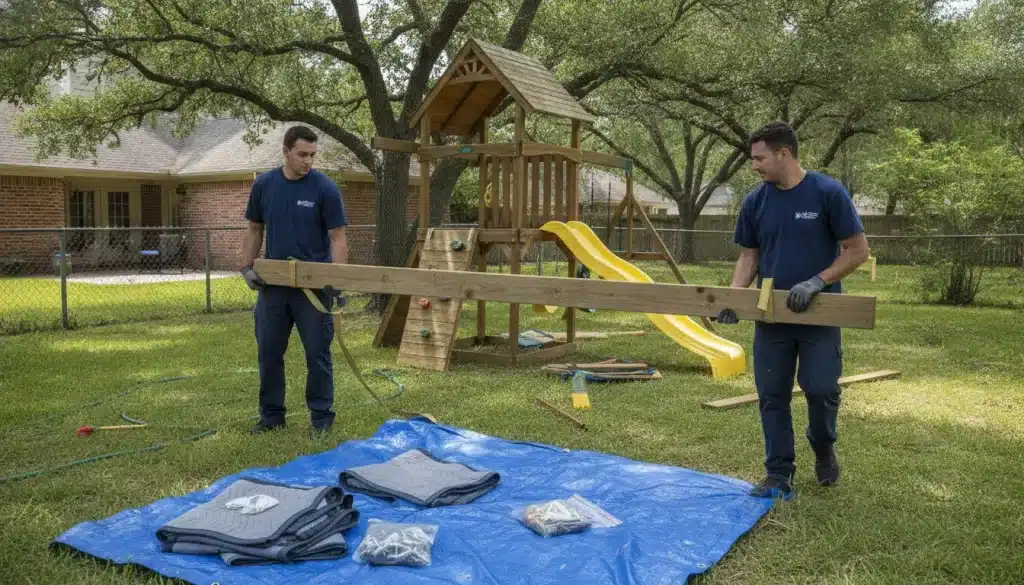
Moving an outdoor playset is less like moving a box and more like moving a small building. A wood or vinyl set can weigh several hundred pounds, sit on buried anchors, and span a swing beam, a slide, and a fort. The safe path is the same every time. Measure the set and the path, photograph every joint, label the hardware, protect the ground, then take it down only as far as the move requires.
Transit Moving Systems moves oversized home items for households in Houston, Tacoma, Seattle, and Denver. If the set is anchored, too wide for the gate, or headed onto a truck, call (346) 646-7955 or request a moving quote before you start pulling bolts.
Decide How Far to Take the Set Apart
Start with the set in front of you, not with a tool bag. A small metal A-frame can sometimes travel intact across a flat yard. A wooden fort with a slide, a climbing wall, and a roof almost never should. A practical swing-set guide draws a useful line. Sets under about 200 pounds on a flat, clear path can sometimes move whole. Sets over about 250 pounds are safer taken down in part or in full.
Treat that weight line as a prompt, not a promise. You will not have a scale under a playset. Judge the job by what you can see, what the path allows, and what your crew can lift without twisting the frame.
- A short metal frame with two swings, a clear gate, and flat ground may move with three or four adults and a dolly.
- Anything with a fort, a slide, or legs set in concrete needs at least a partial takedown.
- A move onto a truck, across a slope, or into storage needs a full takedown.
- Loose joints, corroded bolts, or cracked lumber mean you should not move the set intact. Disassemble it, or retire it.
Consult the manufacturer’s manual if you still have it. Brands such as Rainbow and Creative Playthings rely on proprietary brackets. Guessing at those joints is how people strip bolt heads and split beams. If the manual is gone, the photographs you capture before the first bolt comes out become your manual.
Measure the Playset, the Gate, and the Truck
Measurements determine the method before anyone lifts. Write four numbers: the length and height of the swing beam, the width of the fort, the width of every gate and door on the path, and the deck length of the truck or trailer.
A swing beam is often the component that will not clear a side gate. If the beam exceeds the gate opening, remove it in the yard, not beside the truck. Measure the destination yard the same way. A set that fit the former lot can land on a slope, over a septic field, or too close to a fence.
The U.S. Consumer Product Safety Commission says most playground injuries happen when a child falls to the ground. Its public checklist asks for at least 12 inches of wood chips, mulch, sand, or pea gravel, or a tested rubber mat. That surface should extend at least 6 feet in every direction from the equipment. For swings, it should reach, in front and in back, twice the height of the bar the swings hang from. Plan the new protective surface to those distances before you excavate the first anchor hole. The full home guidance is in the CPSC Outdoor Home Playground Safety Handbook (Publication 324).
Also record overhead utility lines, low branches, and irrigation heads. A beam that clears the gate can still strike a power line or a porch roof on the way out.
Photograph, Label, and Bag Every Piece of Hardware
Take wide photos from all four sides, then close-ups of every bracket, slide mount, and swing hanger. Shoot the underside of the fort floor if you can. Those photographs are what you will trust when one bag of bolts looks identical to three others.
With the photos done, work from the outside in so the fort never stands half-loose while you hunt for a wrench:
- Clear toys, hoses, and tools from the work area. Spread a tarp beneath the set if it sits in mulch or sand so small parts do not disappear.
- Remove swings, trapeze bars, belts, and plastic seats. Coil the chains and tape them so they cannot swing into someone’s face.
- Detach the slide, climbing wall, rope ladder, steering wheel, and canopy. Bag the bolts for each component with a marker note that matches tape on the part.
- Number matching beams and brackets with the same code, such as “beam-L / hanger-L.” Put that code on the photo if you can.
- Leave structural bolts for last. Do not loosen the legs until the swing beam and slide are detached and the fort is supported.
Use separate zip bags, not one coffee can. A single mixed container turns reassembly into a lost weekend. Keep the bags in a rigid box, not a soft sack that can tear in the truck. If a bolt is corroded, stop and apply penetrating oil. Forcing it rounds the head and splits the lumber around the hole.
Protect the Ground, the Wood, and the Path
Surface protection is part of the move, not a cleanup chore. Playsets shed splinters, and metal feet gouge decks and lawns. Wrap beams and slide rails in moving blankets, then tape the blankets so they stay in place. Do not rely on stretch wrap alone over bare lumber. It can trap moisture if the set remains in a truck for several days.
The pieces are only half the job. Protect the path they will travel, or the lawn and the gate take the damage:
- Place plywood or a furniture dolly beneath long beams so they do not drag across pavers or a deck.
- Pad gate posts and door frames. A ten-foot beam pivots and strikes both sides.
- Cover mulch beds with a tarp so anchors, washers, and drill bits remain visible.
- Keep children and pets out of the yard until the final piece is loaded. A half-standing fort is not stable.
For packing materials that resist tearing on rough cedar, see which packing materials hold up on a move. Blankets and ratchet straps matter more here than a stack of small cartons. If you are packing the rest of the household at the same time, choose boxes for the rest of the load so the hardware box is not buried under linens.
Release Anchors Before You Lift
Many wooden sets are not freestanding. Legs may sit in concrete, on ground stakes, or on auger anchors driven into the soil. You cannot roll or lift a structure that is still fastened to the ground. Excavate carefully around each footing and locate the bracket before you pull.
Concrete footings are the difficult case. If the leg is bolted to a buried block, unbolt the leg and leave the block unless the buyer requires removal. If the post is embedded in the concrete itself, cutting the leg and replacing it at the new house is often safer than jacking a buried block out of the lawn. That is a crew job, not a two-person Saturday project.
Metal stakes usually twist out with a wrench or release once the leg bracket is removed. Mark each hole so you do not leave a trip hazard, and fill or cap it before you leave the former yard. Never extract an anchor by rocking the entire fort. That loads the joints and can collapse the structure.
After the anchors are free, support the fort with a helper or a sawhorse before the final beam bolts come out. Lower heavy components. Do not allow a beam to fall onto the lawn or onto someone’s foot.
Choose a Carry Method That Matches the Pieces
Once the structure is in components, match the carry to each piece. Short plastic slides and swing seats can go into the truck by hand. Long beams require two people, a dolly, and a clear turn at the gate.
| Situation | Safer method | Do not do this |
|---|---|---|
| Small metal frame under about 200 pounds, on a flat yard, for a short distance. | Remove the swings. Then lift with three or four adults, or roll the frame on a dolly. | Do not drag it across a slope or through a narrow gate while it is still fully built. |
| Wood fort with a slide, on a local move, after the anchors are already free. | Take off the slide, the swings, and the beam. Then move the fort. | Do not rock the fort to walk it while bolts are still in the ground. |
| Any set going on a truck, a trailer, or into storage. | Do a full takedown. Use blankets, labeled bags, and ratchet straps. | Do not stand a built fort in a truck and hope the straps hold it. |
| Legs in concrete, cracked beams, or a set wider than every gate. | Stop. Hire a crew with the tools to cut, crib, and carry. | Do not keep unscrewing bolts until something breaks. |
On the truck, lay beams flat rather than on end. Strap them to rated anchor points, not to a loose carton. Keep the hardware box reachable at the destination, not buried beneath the beams. A playset that shifts in transit cracks around the bolt holes, and those holes rarely align again.
Access is the hidden constraint. Count every turn, including the back door, side gate, alley, elevator, or a shared driveway. If the only route passes through the house, protect the floors and measure hallway widths before the beam leaves the lawn. A structure that will not fit the route must be separated into shorter sections in the yard.
Put It Back Together in Reverse, Then Make It Safe
Reassembly follows the photographs in reverse. Lay components out in the order they came off. Begin with the fort or the main A-frame, square it, and only then hang the swing beam and the slide. Do not fully tighten every bolt on the first pass. Snug the frame, confirm that it sits level, then tighten.
Level matters more than speed. A frame that twists on a slope pulls brackets out of square and lets swings strike the legs. Shim or excavate so the main posts are plumb. If the new yard is steep, a different location or a different set may be the honest answer.
Finish the safety checks before anyone climbs, including a quick test swing with no child on it:
- Replace bent bolts, open S-hooks, and cracked plastic components. Open hooks can allow a swing chain to slip free.
- Cut or cap bolt threads that protrude. The CPSC checklist flags exposed bolt ends and sharp edges.
- Confirm openings avoid the head-entrapment range the CPSC flags. Spaces should be smaller than 3.5 inches or larger than 9 inches.
- Install the impact surface and the six-foot clearance, with extra length in front of and behind the swings, before children use the set.
- Anchor the structure for the new soil. A set that stood for years in clay can tip in loose fill if the anchors are skipped.
Home playground equipment is manufactured to ASTM F1148, and impact surfacing is specified in ASTM F1292. You do not need to purchase the standards to do a careful job. You do need to follow the manufacturer’s anchor instructions and the CPSC spacing rules above. If a beam is split, a bracket is bent, or the frame will not sit square, do not return it to service.
When a Crew Should Move the Outdoor Playset
A do-it-yourself move fits a freestanding set, a wide gate, a flat route, and at least three adults who will stop if a joint looks wrong. Call for professional help when any of these conditions are true:
- The legs are buried in concrete, or the anchors will not release.
- The swing beam or fort will not pass through the only gate, and cutting or cribbing is required.
- The structure must ride on a truck between homes, including a move among Houston, Denver, Seattle, and Tacoma.
- Lumber is decayed around the bolt holes, or the frame already rocks when a child climbs it.
- You cannot spare a second day if reassembly goes badly. A partially built structure left overnight is a hazard.
A household crew experienced with awkward items is the appropriate call. Specialty movers handle pieces a standard load should not treat like a sofa. Similar judgment applies to other heavy household items, from hot tub moves to pool table moves. A playset is its own project, but the access, padding, and truck plan resemble those moves.
Ask the crew three direct questions. Will they disassemble the set and reassemble it, or only carry pieces you have already separated? How will they protect the lawn and the lumber? What happens if a bolt is seized or a beam will not clear the gate? If the answers stay vague, continue looking. Residential moving should include a walk-through of the route, not a guess from the curb.
Released value and additional valuation are different products. Read how moving protection works before you assume a wooden fort is covered like a carton of books. Playsets are bulky, they scratch easily, and a cracked beam is often a total loss.
If the outdoor playset is anchored, oversized, or traveling with the rest of the household, let Transit Moving Systems plan the takedown and the truck. Call (346) 646-7955 or send the measurements through the contact form.
Frequently Asked Questions
Can I move an outdoor playset without taking it apart?
Sometimes, if it is a small freestanding frame, the route is flat, and several adults can lift or dolly it a short distance. A wooden fort, a set seated in concrete, or any structure going on a truck should come apart first. Moving a heavy set intact stresses the joints and can drop the frame.
What should I measure before moving an outdoor playset?
Measure the swing beam, the fort width, every gate and doorway along the route, and the truck or trailer deck. Then measure the new yard for a level location and for fall-surface clearance of at least six feet around the set, with additional room in front of and behind the swings.
How do I keep the hardware from getting mixed up?
Photograph each joint, then bag the bolts with the component they came from and write the same code on the bag and on tape attached to the lumber or metal. Keep those bags in one rigid box that stays within reach. Do not combine every bolt in a single container.
Who should I call for an anchored or oversized set?
Hire a moving crew when the legs are set in concrete, the beam will not fit the gate, or the structure must travel on a truck. Transit Moving Systems can walk the route with you and move the components with the rest of the household goods. Call (346) 646-7955.