

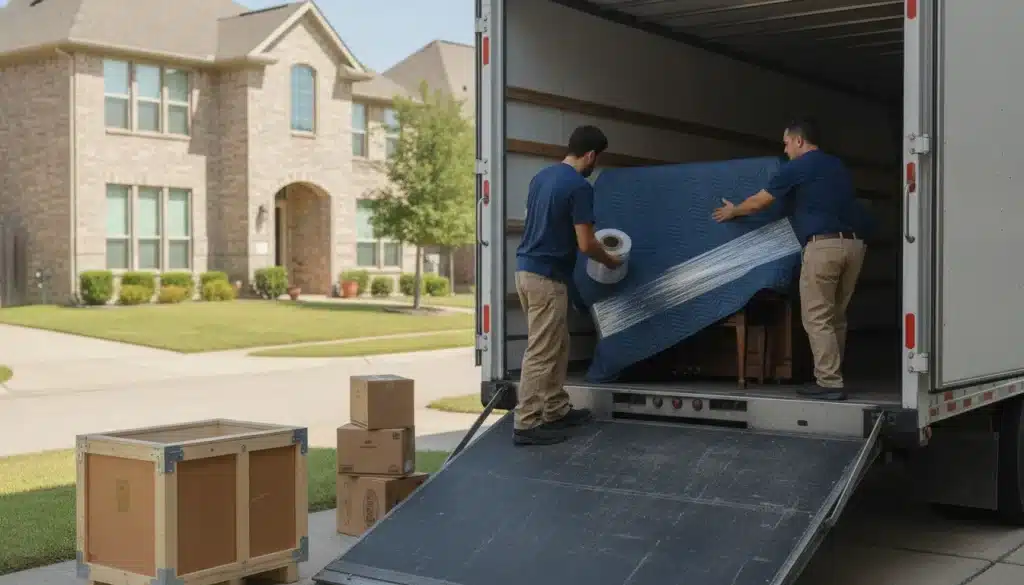
A piano, an antique cabinet, a wine collection, or a heavy safe is not an ordinary box. Specialty movers should tell you, before moving day, how each piece will be packed, which equipment the crew will bring, how stairs and tight doors change the plan, and which valuation option covers a loss. If those answers are missing, the quote is not finished.
Request a written specialty quote
The useful comparison is not a slogan. It is a written plan that names the item, the route through the building, and the protection you are buying. A framed painting may need a custom crate and photos of its condition. A piano estimate turns on the instrument type, the stairs, the access, and the distance. A wine shipment needs a real vehicle and temperature plan, not a promise that someone will be careful.
What specialty movers handle that a standard crew does not
A standard household crew is built for boxes, sofas, and appliances. Specialty movers take pieces whose weight, fragility, climate needs, or path through a building calls for a different plan. Extra hands are not the same thing as the right gear. A grand piano, a framed painting, and a residential safe each create risks that do not show up on a typical room-to-room move.
Transit Moving Systems lists art and antiques, pianos, wine collections, safes, pool tables, and hot tubs among its special moving services. Those are service categories, not fixed-price bundles. The scope depends on the item and the building. A piano estimate can change with the instrument type, the distance, the stairs, and the access. A safe quote depends on weight, distance, stairs, and how hard the route is. An item that fits in a room can still be hard to get through a doorway.
- Art and antiques. Fragile or high-value pieces can need custom crates, padded handling, and notes and photos taken before the truck leaves.
- Pianos. Weight, a delicate case and action, and a narrow stair path make them unlike a dresser of the same footprint.
- Wine collections. Bottles break easily, and heat or cold can spoil them. Transit’s wine page describes climate-controlled vehicles and wine-specific boxes. Confirm the vehicle and temperature for your shipment.
- Safes. Extreme weight plus stairs or a tight turn can require a different crew and dolly than a household cabinet.
- Pool tables. Slate, cloth, and a large frame mean the job may include taking the table apart, not only carrying it.
- Hot tubs. Bulk, outdoor placement, and a disconnect from water and power change the scope before anyone lifts the shell.
A qualified crew should talk about the item, both addresses, the access, and the paperwork before the date is locked. That conversation is how you tell a prepared team from a general crew that simply said yes.
Questions to ask specialty movers before you book
Good questions force a plan. You want answers about your item, your building, and the road between them. Vague comfort is not a plan. Group the call into four topics: planning, protection, equipment, and access.
Planning
Start with the inventory. A mover who has not seen the piece, or at least photos and measurements, is guessing. Ask whether the piece travels alone or rides with the rest of the household. A solo shipment can be the safer choice for a collection, and it can also change the timing and the truck.
Protection
Ask who packs, which materials they use, and whether a custom crate is part of the job or an extra you must request. For wine, ask whether the truck is climate controlled and how they confirm the temperature on that route. Blankets are fine for many antiques. They are not a crate, and they are not climate control.
Equipment
The crew should name the tools, not just the headcount. A piano board or skid, a safe dolly, stair equipment, and enough people to control the load are different answers. If the mover cannot name the gear for your piece, they have not planned the move.
Access
Stairs, elevator reservations, door widths, parking, tight turns, and a door that has to come off all belong in the quote. If the estimator never asks, the number on the page is incomplete.
- Can you review an inventory of each hard piece, including type, size, condition, and photos, before you write the plan?
- Will this piece travel by itself, or with the rest of the household shipment, and which dates work?
- Who packs the item, which materials do you use, and will you build a crate where a blanket is not enough?
- For wine, will you use a climate-controlled vehicle and wine boxes, and how will you confirm the temperature for this shipment?
- Which equipment will you bring, such as a piano board, a safe dolly, stair tools, padded covers, or extra people?
- How will you record the item’s condition with notes and photos before the truck leaves, and when can I see that record?
- Which access facts do you need from me, including stairs, elevator rules, door widths, parking, and any door that must come off?
- Which valuation option is on this estimate, and which pieces must be listed by name on the shipping papers?
The answers should match the item. A piano, an antique, or a painting can need a different handling plan than a sofa. Read the company’s art, antique, and piano moving page for the kind of preparation and photo record to ask about. For a cellar, ask the same level of detail about packing, temperature, and inventory, and compare it with the wine collection moving service.
Write the answers down and ask that the important ones appear on the estimate. If the mover cannot say who packs, which equipment is required, or how the crew will get through your building, keep looking.
How valuation works on a high-value move
“We are insured” does not tell you what you are paid if a piece is lost or damaged. Valuation is the mover’s liability option. It is not the same thing as an insurance policy you buy from a separate carrier. Before you book specialty movers, ask which option is on the paperwork, what you must list, and what the written estimate actually says.
For a move across state lines, the Federal Motor Carrier Safety Administration says household-goods movers must offer two liability options: Full Value Protection and Released Value. Released Value is free, and it is thin. Responsibility is limited to no more than 60 cents per pound per article. The agency’s own example is a 25-pound television, which would pay $15. Read the FMCSA liability options before you sign a waiver.
Full Value Protection is the default unless you waive it in writing. Under that option, the mover may repair the item, replace it, or pay, subject to the shipment terms. Items worth more than $100 per pound are treated as extraordinary value. Those pieces need to be listed on the shipping documents. If they are not listed, the mover may limit responsibility for them. A light sculpture or a small painting can fall into that group even when a heavy safe does not.
Transit publishes its own moving valuation options on a separate page. Minimum liability is stated as $0.60 per pound on lost or damaged items. Extended valuation is described as $5 per $1,000 for a move inside one state and $13 per $1,000 for a move between states, with a $500 deductible and a $10,000 minimum payable. An additional plan is described as $100 per pound only when the items are listed on the inventory at that value. The page also says goods in storage are covered at 60 cents per pound, with a charge of $3 per $1,000 of valuation for each month in storage. A written estimate is what confirms which option applies to your job.
Rules inside one state can differ from the federal interstate rules. Do not assume the FMCSA explanation answers a local Houston, Tacoma, Seattle, or Denver move by itself. Ask for the valuation choice in writing. Then check that high-value pieces are named on the inventory. Replacements, on Transit’s page, are for items confirmed lost or damaged beyond repair. If a piece can be repaired, the company pays for the repair.
Weight is a poor stand-in for worth. A 10-pound painting can be worth far more than a 400-pound sofa. That is why the inventory, not a spoken promise, is the document that matters when specialty movers handle pieces whose replacement cost has little to do with the scale.
What changes from one hard item to the next
The same crew can be right for one piece and wrong for the next. Use the table as a checklist, then make the estimator answer the row that matches what you own. Specialty movers should treat these as different jobs, even when they ride on one truck.
What to confirm before you book a hard piece
| Item | Main risk | What to confirm in writing |
|---|---|---|
| Fine art | Surface damage, vibration, or packing that is too light for the piece. | Custom crates where needed, plus notes and photos of each piece before it moves. |
| Antique furniture | Age, fragile joints, and a value that ordinary furniture handling does not assume. | Which pieces need specialist handling, who notes existing damage, and how condition is recorded. |
| Piano | Instrument type, stairs, and tight access can change the job more than miles do. | Piano type, distance, stairs, and access on the estimate. The piano moving guide covers the move itself. |
| Wine collection | Heat, cold, and poor packing can ruin bottles that never crack. | Climate control, often described at 55 degrees, plus corrugated or polystyrene wine boxes. Confirm the actual vehicle. |
| Safe | Weight, stairs, distance, and a hard path change the crew and the equipment. | Weight, stairs, distance, difficulty, and the gear. See the safe moving page for the service, not a rate. |
| Pool table or hot tub | The job may include taking the piece apart or disconnecting it, not only carrying it. | Whether disassembly or disconnect is in the written scope. See pool table movers or hot tub movers if that piece is yours. |
Do not accept one blanket quote that ignores which pieces need extra people or gear. Ask for the item, the access, and the included work in writing before you set a date. Example prices you may see on a general article are not a Transit rate card. This company quotes the job.
Access, stairs, and timing decide the crew you need
Miles are only part of a specialty move. A piano or a safe can travel a short distance and still need a careful plan if it must climb stairs, turn a tight landing, or pass a narrow entry. Type, distance, stairs, access, weight, and difficulty are estimate factors. They are not a promised clock time. An elevator hold, a loading zone, or a truck that cannot park at the door can change the work as much as the highway does.
Walk the path before you ask for a number. Count the steps and the landings. Measure the narrowest door. Ask the building whether the elevator must be reserved and whether a door or railing is allowed to come off. The clearer you are about what the building allows, the more useful the estimate is. The piano moving tips page covers how a piano moves. This section is about telling the crew what the building will permit.
- Stairs, landings, ramps, and every change in level on the path.
- Tight turns, low ceilings, narrow halls, and the smallest doorway.
- The elevator cab, its door, the reservation rule, and any posted weight limit.
- Street parking, the walk from the truck to the door, and time limits on the curb.
- Doors, railings, or gates that may have to come off, and who may remove them.
- The piece itself from more than one angle, including how it sits in the room.
Send those photos with the request. Transit serves Houston, Tacoma, Seattle, and Denver. Specialty movers can use the images to spot access problems before the day is booked, instead of discovering a spiral stair with the piano already on a board.
Timing belongs in the same conversation. A building that only allows a freight elevator on weekdays, or a street that bans trucks at rush hour, can force a different crew size. Say so early. A quote that assumes an open curb and a wide stair is a different job from the one you actually have.
Red flags on a specialty moving estimate
A useful estimate makes the plan easier to read, not harder. Before you choose among specialty movers, check that the quote names each major piece, explains the protection, accounts for the building, and says who packs. Transit prepares tailored quotes and does not publish a specialty rate card, because the work depends on the item and the path. You can request a written quote and compare every bidder on the same facts.
- No item list. A line that says only “specialty items” does not show what was priced. Look for the piano, safe, artwork, or antique by name.
- No stairs or access. If the estimate never asks about steps, elevators, or parking, the crew has not priced your route.
- “Fully insured,” with no choice. That phrase does not name a valuation option. The estimate should say which option applies and what you must list.
- A large cash deposit up front. Pause if someone wants a big cash payment before the scope, the inventory, and the terms are written down. Ask for the amount, the method, and the refund terms.
- A hard piece priced like a sofa. A piano or a safe should not be treated like ordinary furniture with no note about weight, access, or gear.
- No written inventory. If condition and contents are not listed, a later claim has little to stand on.
None of these signs proves a scam by itself. Together they mean the quote is not ready to sign. Ask for the missing piece in writing. A mover who will not add it is telling you how the move will be run.
How to compare two quotes without getting lost
Two numbers are not comparable until they describe the same work. Lay the estimates side by side and check five lines: the items named, the packing included, the equipment named, the access assumed, and the valuation option. If one quote includes crating and the other assumes you packed, the cheaper line is not cheaper. It is a different job.
Ask each company to mark what is excluded. Door removal, elevator fees, long carries from the truck, and a second trip for a piece that will not fit are common gaps. A clear exclusion is better than a surprise on moving day. If you are also storing a piece between homes, ask whether storage valuation is a separate charge. Transit’s storage note is 60 cents per pound, plus $3 per $1,000 of valuation each month, and that figure should be confirmed on your paperwork rather than assumed.
Then look at who shows up. A specialty move can share a truck with a household load, or it can be a separate appointment with a smaller crew and the right tools. Neither is automatically better. The better quote is the one that says which it is, and that matches the piece you described. Keep the photo inventory you sent. It is the record of what the estimator saw.
Ready to price the hard pieces, not a guess? Call Transit Moving Systems at (346) 646-7955 or request a quote that names each item, the access, and the valuation option.
Frequently Asked Questions
What should I ask specialty movers before I book?
Ask how the crew will look at the item, protect it, move it through doors and stairs, and record its condition. Confirm who packs, whether a crate is part of the job, which access details they need, and which valuation option will be on the written estimate.
Are specialty movers the same as full-service movers?
Not always. A full-service crew can pack a normal household. Specialty movers add a plan for pieces that are unusually heavy, fragile, valuable, or sensitive to heat and cold. Some companies do both. The test is whether the quote names the hard pieces and the gear, not the company slogan.
How do I know a quote covers my piano, safe, or art?
The estimate should name the piece and the factors that change the work. For a piano, those factors include instrument type, distance, stairs, and access. For a safe, they include weight, distance, stairs, and difficulty. Art should mention crates and a photo record when the piece needs them. A single line that says “furniture” does not cover this.
What valuation should I choose for a high-value piece?
For an interstate move, federal rules say movers must offer Full Value Protection and Released Value. Released Value is free and pays no more than 60 cents per pound per article. Full Value Protection applies unless you waive it in writing. List pieces worth more than $100 per pound on the shipping papers. Transit’s own page lists minimum liability of $0.60 per pound and an extended option with published per-thousand rates. Your written estimate confirms which one you selected.
Do I need a different company for wine, antiques, and a safe?
Not always. One company can handle the set if the quote treats each piece on its own row. Wine still needs a climate plan. Antiques and art still need a condition record. A safe still needs a weight and access plan. If one of those rows is blank, ask for it before you book, or split that piece onto its own job.