

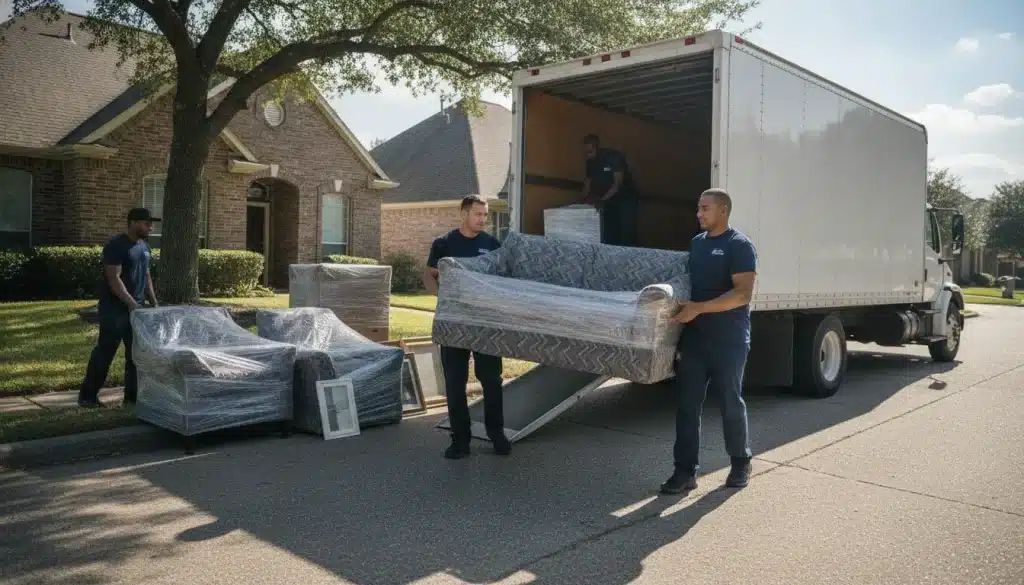
Choosing between local vs long distance movers is not a mileage guess. The right full-service scope depends on whether the shipment stays inside one state, what the price is built from, how long the goods are in transit, and whether you need storage between homes. Get that call wrong and the estimate, the paperwork, and the delivery window will not match the move you are actually making.
Call (346) 646-7955 to book your move, or request a quote online.
Transit Moving Systems is a full-service moving and storage company. The core work is residential long-distance moving, with local moving in Houston, Tacoma, Seattle, and Denver as the next service people ask for. If the haul is already long and you want practical ways to keep the plan tight, see our budget long-distance move tips. This guide walks the earlier decision. It does not replace a written estimate, and it does not cover renting a truck.
What Separates Local vs Long Distance Movers
People often treat “local” as a short drive and “long distance” as anything past a few hours. That shortcut causes bad quotes. A move across Houston, or from Tacoma to Seattle, can finish the same day with one crew. A move that leaves the state is a different job, even when the miles look modest on a map.
The Federal Motor Carrier Safety Administration defines an interstate move as transportation between a state and a place outside that state, or between two places in one state when the shipment passes through another state. The truck itself does not have to cross the line. If the goods cross a state line and a mover handles any part of the job, that portion is interstate and FMCSA rules apply. FMCSA explains the scenarios on its interstate move page.
Use that test first. A same-day move inside the Houston area, or between Tacoma and Seattle, is local full-service work. A home move from Houston to Denver, or from the Seattle-Tacoma area into another state, is long-distance work. If the route is unclear, ask the mover and the state before you book. Do not let a round number of miles decide it.
Two other edges are easy to miss. A shipment that starts out of state and stops at a warehouse inside your state can still be interstate, because origin matters. A trip that stays in one state but rolls through a neighboring state on the highway can be interstate too. Say the real origin and destination when you request the quote, including any warehouse stop.
How Planning Changes With the Service Scope
A local move is a tight calendar. You pick a day, the crew arrives, and the goods usually land at the new address before that crew is done. Stairs, a long carry from the truck, and a building’s elevator window are the details that change the plan. You still want a walkthrough so the crew size matches the home, but you are not building a multi-day route.
A long-distance move needs a plan before the truck is assigned. Transit Moving Systems puts a relocation specialist on interstate work to set the timeline, the volume of goods, and any special handling. Packing, a shuttle for a tight driveway, and storage between addresses all belong in that plan, not as surprises on moving day.
Inventory matters more once the goods leave town. A local crew can see the house and adjust. A long-haul shipment is priced and loaded from what was listed. Pianos, antiques, artwork, and wine need to be named up front so the right materials are on the truck. Our packing and unpacking service covers that prep when you do not want to pack the house yourself.
Tell the specialist about access at both ends. A downtown Houston high-rise and a Tacoma house with a steep drive do not load the same way. If the over-the-road van cannot reach the door, a smaller shuttle finishes the carry. That is normal on some long-distance jobs. It should be in the plan, not discovered at the curb.
- Confirm whether the shipment stays in one state or crosses a state line.
- List rooms, large furniture, and anything that needs special handling.
- Share elevator rules, long carries, and parking limits at both addresses.
- Decide whether goods go straight to the new home or into storage first.
- Ask for one written scope that matches that answer before you reserve a date.
Pricing Inputs, Not a One-Size Rate
Local and long-distance full-service moves are not priced from the same inputs. Treating them as the same rate is how people compare two quotes that are not the same job.
On a local move, the bill usually follows time and crew. How many movers, how many hours, how many stairs, and how far the truck sits from the door all move the number. A short in-town job in Denver or Houston can stay on one clock from load to unload. Extra stops and heavy items add time, so they belong in the walkthrough.
On a long-distance move, weight or volume and the length of the haul drive the transportation charge. Fuel, tolls, and the days the goods are on the road are part of that picture. Packing, shuttle service, long carries, and storage are separate lines. They are not folded into a single hourly rate the way a same-day local move often is.
Transit Moving Systems does not publish a flat price for either scope. The quote comes from your inventory, access, and dates. Ask for the pricing inputs in writing so a local hourly plan is not set next to a long-distance weight-and-distance plan as if they were equal.
| Decision point | Local full-service move | Long-distance full-service move |
|---|---|---|
| Typical trip | Same metro. Goods stay in one state. | Crosses a state line. Or it passes through another state. |
| Main price inputs | Crew size, hours, stairs, and carry distance. | Weight or volume, haul length, fuel, and extra services. |
| Transit | Often the same day with one crew. | A delivery spread, not a same-day promise. |
| Rules | State and local requirements. | FMCSA interstate rules for the mover’s portion. |
| Storage | Usually optional and short. | Common between pickup and a set delivery date. |
Read the lines, not the headline number. A lower local quote that excludes packing is not cheaper than a long-distance quote that includes it. Match the services first, then compare.
Transit Time and Scheduling
Local transit is simple to explain and easy to get wrong if the building is not ready. One crew loads, drives across town, and unloads. The schedule breaks when a freight elevator is booked by someone else, the truck cannot stage on the street, or a last-minute room was left off the list. Those are same-day problems. They do not create a multi-day delivery window.
Long-distance transit is a range. Goods may share the trailer with a planned route, and the delivery date is a spread rather than a clock time. Pickup can be one day and delivery several days later. If you need a firmer arrival, say so when the specialist builds the plan. Do not assume a cross-country haul runs like a Houston-to-suburb job.
Scheduling also follows the office that books the work. Transit Moving Systems sales hours are Pacific Time: Monday through Friday, 6:30 a.m. to 5:00 p.m., Saturday 9:00 a.m. to 2:00 p.m., and Sunday 9:00 a.m. to 1:00 p.m. Calling inside that window gets you a person who can turn an inventory into a date. For a long haul, book early enough that packing and any storage dates sit on the same calendar.
Build a small buffer on either scope. A local move can still slip if the elevator window is shared. A long-distance move should not be planned against a same-morning flight. If closing dates are tight, tell the specialist before the truck is assigned so the spread is honest.
Rules, Paperwork, and Protection
Interstate household-goods moves fall under FMCSA consumer rules. That covers registration, the written estimate, and the documents you sign before the truck leaves. Transit Moving Systems treats that compliance as part of the long-distance service, not as paperwork you chase on your own. If you are unsure the trip is interstate, ask before you sign. A wrong label produces the wrong form.
A move that stays inside one state follows that state’s rules instead. The practical difference for you is the paper and the delivery promise, not the care the crew uses on the furniture. Either way, read the bill of lading before you sign it. FMCSA describes that document as both the receipt for your goods and the contract for their transportation.
Protection is a separate choice from the move itself. Released-value coverage and broader protection are not the same product, and a local hourly move does not automatically include what an interstate shipment must offer. Our moving insurance page is the place to see how Transit Moving Systems handles that conversation. Ask which option applies to your scope, and get the answer on the estimate rather than at the curb.
Red flags look similar on both scopes. A company that will not put the scope in writing is a problem on an 8-mile drive or an 800-mile one. So is a firm that pressures a large cash deposit, or that will not explain who shows up on moving day. Credentials and a real inventory still matter. This comparison only tells you which scope to request.
When Storage Belongs in the Move
Storage is the point where a simple “which mover” question becomes a timing question. On a local move, storage is usually optional. You might hold a few rooms while paint dries, or stage an estate for a short gap. The crew can often deliver the rest the same day.
On a long-distance move, storage is common and should be planned. Closing dates slip. A Seattle-area pickup and a Denver delivery rarely land on the same morning. Storage-in-transit keeps the goods in the mover’s care between those dates instead of forcing them into a spare room or a rental truck. Transit Moving Systems offers storage services at its warehouses for that gap, separate from a self-storage unit you would load yourself.
Say the dates out loud when you book. If the new home is not ready, the estimate should show storage, the handoff, and the later delivery. Adding a warehouse stop after the truck is loaded changes both the bill and the schedule. It can also change whether part of the shipment is treated as interstate. That is a planning choice, not a moving-day fix.
Short local storage and storage-in-transit are different products. One holds goods near the origin for a few days. The other keeps them in the mover’s system until the destination date is real. Ask which one is on the estimate so you are not billed for a service you did not need, or left without one you did.
Which Scope Fits Your Move
Choose local full-service movers when the home stays in one metro and the goods do not cross a state line. Houston, Tacoma, Seattle, and Denver in-town moves are the usual fit. You want a crew sized to the house, a same-day plan, and a price built from hours and access. Start with residential moving if the shipment is a household, then confirm the city page that matches your origin.
Choose long-distance movers when the shipment leaves the state, passes through another state, or needs a delivery spread and storage between addresses. Houston to Denver is the clearest example we see. Seattle-Tacoma origins headed out of Washington are the other. The long-distance moving service is the page for that scope, with city pages for Houston long-distance moving, Seattle movers, and Denver long-distance moving when you want the origin spelled out.
A few cases still need a person, not a chart. Describe the full route on the quote form if the trip stays in Texas but detours through another state. Do the same if goods pause in storage out of state, or if one home mixes a local unload with a later interstate leg. The specialist can match the scope. You should not have to guess which rule applies.
If you already know the haul is interstate and you are comparing companies, use a hiring checklist on that decision alone. This page stays on the earlier question: which service you need before you compare crews.
Call (346) 646-7955 or request a quote and tell us the origin, the destination, and whether you need storage between them. We will match the scope before we talk dates.
Frequently Asked Questions
What is considered long distance for a moving company?
For household goods, federal rules look at state lines, not a mile cutoff. FMCSA treats a move as interstate when goods go from one state to another, or stay in one state but pass through another. A same-metro move that never leaves the state is the local scope. Ask your mover if the route is close to a border.
Do local and long-distance movers charge the same way?
No. Local full-service moves are often built from crew size and hours, plus stairs and carry distance. Long-distance moves are built from weight or volume and the haul, with packing, shuttles, and storage as extra lines. Compare those inputs on the written estimate. Do not compare one hourly total with one weight-and-distance total.
How long does each type of move take?
A local move in Houston, Tacoma, Seattle, or Denver is often finished the same day by one crew, as long as the elevator and parking are ready. A long-distance move uses a delivery spread. Pickup and delivery are different days, and storage can sit between them. Ask for the spread when you book, not after the truck is loaded.
Can I store goods between pickup and delivery?
Yes. Short holds are optional on many local moves. Storage-in-transit is common on long-distance moves when the new home is not ready on pickup day. Transit Moving Systems can keep goods in its own storage instead of a unit you load yourself. Put the dates on the estimate so the later delivery is scheduled.
Which phone number should I use?
Houston is (346) 646-7955. Tacoma is (206) 333-2905. Denver is (720) 704-8450. Sales answers on Pacific Time hours listed above. You can also send the origin and destination through the contact form and ask for the matching full-service scope.