

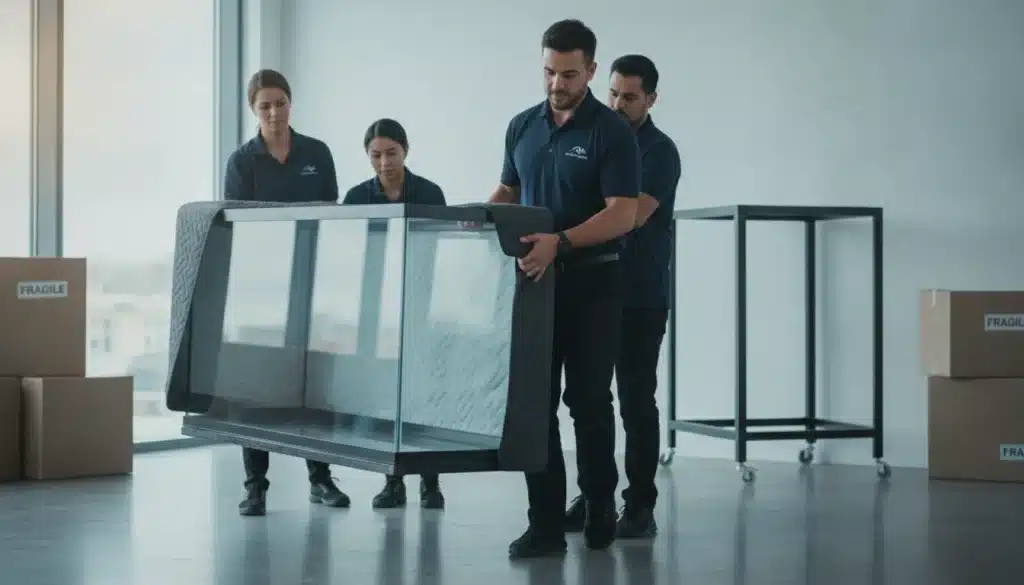
Aquarium moving cost depends on more than tank dimensions. Livestock, water and substrate handling, equipment, travel distance, access at both homes, and who will reconnect the system all affect the work. A useful estimate starts with the aquarium as a living system, not simply a heavy object to place on a truck.
Transit Moving Systems provides moving and storage services, but the appropriate scope for an aquarium must be confirmed for the specific route and setup. This guide explains what to discuss before requesting an estimate. It does not assign a flat price: tanks, inhabitants, service scope, and access vary too much for a reliable universal figure. Treat the aquarium as a distinct part of the household move and get each party’s responsibilities in writing.
What does aquarium moving cost include?
An estimate may cover a crew to move a drained, empty tank and boxed equipment. A broader plan might also involve coordinating containers for livestock, handling water and substrate, protecting filtration equipment, or placing the tank at the destination. Those are different jobs. The same request to “move the aquarium” can describe very different amounts of labor, preparation, and responsibility.
Before comparing estimates, ask which work is included and which remains yours or another specialist’s responsibility. Confirm who will handle fish and other livestock, whether water and substrate are transported, how the tank is protected, and whether “setup” means placing the equipment or reconnecting and checking the system. Do not assume that a general household move includes aquarium-specific service.
A practical way to think about the scope is to separate it into three workstreams: the glass or acrylic tank and stand; the living system, including animals and biological filtration; and the supporting equipment and supplies. Each may need different preparation or a different provider. A moving estimate is useful only when it makes clear which workstream it covers.
Aquariums can be vulnerable to stress, temperature changes, and disruption of an established environment. Ask a qualified aquarium professional for system-specific guidance on inhabitants and biological filtration. A moving crew should have a clear, agreed scope rather than being asked to make animal-care or aquarium-management decisions on move day.
Which factors change the estimate?
Tank size, weight, and construction
Dimensions are only the starting point. Empty weight, glass or acrylic construction, shape, stand, canopy, and condition all influence how the tank can be protected and carried. A large or unusually shaped tank may need additional people, a particular lifting approach, a wider route through the home, or a different vehicle arrangement than a small, empty aquarium.
Give the estimator the length, width, and height; approximate capacity if known; construction material; and photographs of the tank, stand, and any visible damage. If it is built into cabinetry or has a custom frame, explain how it is attached and whether it can be separated. Do not estimate the handling load from water capacity alone. The tank, stand, fixtures, and any remaining contents all matter, and a proper assessment is needed to plan safe handling.
Condition matters as well. Point out existing chips, cracks, loose trim, repaired areas, or a stand that appears uneven or unstable. Photograph the whole setup and close-ups before work begins. These details help the estimator understand what is being handled and give you a record of its condition; they are not a substitute for a qualified assessment of whether the tank can be moved.
Livestock and the plan for living contents
Fish, corals, plants, invertebrates, and other inhabitants can make an aquarium move more complex than transporting furniture. The number and type of animals, their sensitivities, and the time away from a stable system influence the plan. A mover should not be assumed to have animal-care expertise simply because it moves household goods.
Tell the estimator what the aquarium contains and how long the move is expected to take. Ask who prepares and transports the animals, what containers or temperature controls may be needed, and whether you should arrange a specialist for that portion. For a long-distance or international relocation, make sure qualified parties have considered the route and relevant transport requirements. Do not leave these decisions until the crew arrives.
For example, a quote for transporting an empty tank is not comparable to a quote that also includes a coordinated livestock plan. In the first case, you may be arranging animal care separately. In the second, more planning and responsibility may be involved, but you must confirm exactly what the provider will do and what expertise is available. Compare the written task list, not the label on the package.
Water, substrate, and filtration
Water is heavy, and a filled aquarium is generally not a routine household item to haul as-is. The amount of water to retain or replace, the substrate type and depth, and the plan for established filtration can affect labor, supplies, timing, and setup. A system with a deep bed, live rock, or a complex filter arrangement needs a more specific discussion than a small empty tank with dry accessories.
Ask whether the estimate assumes the tank will be drained before the crew arrives. Clarify whether water will be transported, discarded, or replaced at the destination, and who will decide how substrate and biological filtration are handled. These are aquarium-care decisions. Follow suitable professional guidance rather than treating a moving estimate as a prescription for maintaining the system.
Include the water plan in the schedule as well as in the scope. If the tank must be prepared before the crew arrives, establish who will do that work, when it must be complete, and how the crew will know the tank is ready to handle. If the destination is not available immediately, ask how that delay affects the plan. A vague assumption that the crew will “deal with the water” can cause confusion and delay.
Equipment and accessories
Lights, filters, pumps, heaters, chillers, controllers, tubing, stands, lids, and backup systems may need separate packing, labeling, or protection. Small components can take time to disconnect and organize. A complex setup also creates a risk that a part or cable will become separated from the tank it belongs to.
Photograph connections before disconnecting anything. Make an inventory, group related pieces, label containers clearly, and ask which materials and handling steps are included. If you also want help packing household items, identify that separately. Transit’s packing services are a distinct service to discuss, not an automatic aquarium-care package.
Separate fragile or specialized components from general household boxes if their handling needs differ. For instance, a labeled container for a filter’s detached parts is easier to reconcile than several unmarked bags of fittings mixed with room contents. Agree in advance whether the customer, moving crew, or aquarium specialist will disconnect, pack, unpack, and reconnect each item. This division of work makes the estimate more precise and reduces last-minute questions.
Distance, timing, and route
Travel time and distance affect transportation and scheduling. A local trip may allow a shorter interval between disconnection and arrival. A longer journey adds time and can make planning for livestock transport and system stabilization more important. Share the route, dates, expected travel duration, and any stops or storage needs before the estimate is prepared.
Distance should not be considered in isolation. A direct route with confirmed access and a prepared destination differs from a move with a date gap, a required stop, or uncertain delivery timing. Ask how the planned pickup and delivery window relates to the aquarium preparation plan. Do not assume that an ordinary household delivery schedule will fit the needs of live contents.
For a move beyond the local area, review Transit’s cross-country moving information and ask which parts of the aquarium move can be accommodated on the requested route. That page does not establish that every specialty setup is available on every lane; get confirmation for your particular aquarium and destination.
Access at pickup and delivery
Stairs, narrow hallways, tight turns, elevators, long carries, parking limits, and restricted building hours can change the crew and time required. The path from the tank’s current location to the vehicle matters as much as the route into the new home. Mention doors and steps. Share photos or a short video of both paths when possible.
Describe the destination too: where the tank will sit, whether the stand is ready, whether the floor and electrical arrangements are prepared, and whether the crew can reach the placement area. Building rules or elevator reservations may affect timing. A site or access review can reveal a tight turn, threshold, or carrying distance that would otherwise be missed.
Walk the route as if the tank were being carried, not just as if a person were walking through. Note doorways that narrow when opened, corners where the tank must turn, overhead fixtures, stairs with landings, and any section shared with other residents. Measure likely pinch points and photograph them with the surrounding space visible. At delivery, identify the exact room and final placement area so the estimate does not assume an easier route than the one you need.
Setup, storage, and timing gaps
“Setup” can mean carrying the tank and stand into a room, or it can mean reconnecting equipment and assisting with a return to operation. Confirm the exact endpoint in writing. If an aquarium specialist must test or reestablish the system, identify that responsibility and arrange it separately.
If move-out and move-in dates do not align, ask whether storage is appropriate for the equipment and other household goods. Do not assume that a live aquarium can go into ordinary storage. Transit describes storage services, but whether particular components or timing can be accommodated must be confirmed directly.
Make a simple sequence with time windows: when the aquarium professional will prepare the system, when the tank and equipment will be ready for pickup, when the destination can receive them, and when reconnection or restart support is expected. The sequence is as important as the dates. If one provider finishes later than expected, the next provider should know who makes the decision about timing and how to contact you.
How can you compare estimates fairly?
Compare the defined work, not only the totals. An estimate that excludes livestock coordination, difficult access, or setup is not directly comparable to one that includes those tasks. Ask each provider for a written scope, who performs each task, what is excluded, and what circumstances could change the estimate. Do not treat a low number as proof that the same work is covered.
| Estimate area | Details to provide | What to confirm |
|---|---|---|
| Tank and stand | Dimensions, material, shape, condition, and photos | Protection, crew, lifting plan, and placement scope |
| Livestock | Types and approximate quantities of inhabitants | Who prepares and transports them; whether a specialist is needed |
| Water and substrate | Water plan, substrate type, and filtration arrangement | Drainage, transport, replacement, and restart responsibilities |
| Equipment | Filters, pumps, lights, heaters, controllers, and accessories | Disconnecting, packing, labeling, reconnection, and testing |
| Route and access | Addresses, distance, stairs, elevators, turns, and parking | Travel assumptions, building arrangements, and timing |
| Storage or setup | Date gap and desired condition at delivery | Suitable handling, storage limits, and exact service endpoint |
Ask for each quote to identify its assumptions. Does the estimate assume the tank is empty, the stand is separate, the path is clear, and the destination is ready? Are packing materials included? Is setup excluded? Are travel times, building reservations, or a second visit accounted for? A written list of assumptions exposes gaps that a headline total cannot show.
Transit’s guide to getting moving quotes can help you prepare for a broader household estimate. For the aquarium, share the details above and request a site-specific review. Avoid relying on a price per gallon or generic online range unless it describes the same tank, contents, route, and level of service. There is no responsible way to infer an aquarium-specific total from capacity alone.
Industry conditions can also affect moving estimates generally. The International Association of Movers discusses labor, fuel, and warehousing among the cost pressures in its moving industry cost overview. That general discussion does not establish an aquarium-specific price or predict the amount for an individual job. The tank, route, access, and agreed scope still need to be assessed directly.
What should you prepare before requesting a quote?
Put the details together before calling or filling out a request. A concise, well-documented description helps an estimator see the real work sooner and helps you identify aquarium-care questions that need a separate specialist.
- Record the aquarium details. Note dimensions, construction, stand, approximate capacity, condition, and whether it is freestanding or built in. Include photos from several angles, plus a close-up of any existing damage or unusual support structure.
- Inventory the living system. List inhabitants and plants, substrate, filtration, water needs, and any especially sensitive components. Ask an aquarium professional what information is useful for care planning; do not ask the moving crew to decide how to care for livestock.
- Define who does what. Decide which tasks need an aquarium professional, which you will manage, and what you want the moving company to handle. Keep animal care and physical transport responsibilities distinct and state the handoff points.
- Document equipment. Photograph connections before disassembly. List accessories, cables, and parts that need to stay with the setup; label containers so components remain identifiable. Note anything that must stay upright or needs separate protection.
- Map both access paths. Include stairs, doors, turns, elevator dimensions or reservations, parking, carrying distance, and placement location. Photos can make a route easier to assess. Mention restrictions on loading or building hours.
- Set the timeline. Share pickup and delivery dates, expected travel time, building restrictions, and any gap that might require storage or a separate specialist appointment. Identify who will be present at each handoff.
- Request a written scope. Ask for included labor, packing, transportation, setup, exclusions, and the conditions that could change the estimate. Ask whether a site review is needed before the scope is settled.
- Confirm the working arrangement. Ask who will perform the work and who is responsible for each specialized task, especially if multiple providers are involved. Request a contact plan if dates or access conditions change.
For broader moving options, review Transit’s moving services. A conversation can establish whether a requested scope fits the route and confirmed capabilities; it is not a substitute for a detailed written estimate.
Which questions should you ask before booking?
Use these questions to turn a general estimate into a plan you can evaluate. Ask for specific answers instead of assuming a service name covers every detail.
- Does the estimate cover an empty tank only, or does it include equipment and accessories?
- Who is responsible for livestock, water, substrate, and filtration decisions?
- What protection and lifting plan is included for the tank and stand?
- How are stairs, narrow access, long carries, parking, and building reservations reflected?
- Does the scope include setup or reconnection, or only delivery to a room?
- What happens if delivery dates change or storage is needed?
- Which tasks require an aquarium specialist, and who arranges that provider?
- What information or site review is needed before the estimate is final?
- Which assumptions could change the price or schedule after the estimate is prepared?
Call to request a site-specific estimate
Frequently asked questions
Can I get a reliable aquarium moving price online?
An online range may be a rough starting point, but it cannot account for your tank construction, inhabitants, route, access, and service scope unless those details are included. Request a written estimate based on the actual setup rather than treating a generic figure as a quote.
Should the tank be moved full?
Do not assume a filled aquarium can be moved safely as-is. Preparation depends on the tank and system. Ask the manufacturer or a qualified aquarium professional for tank-specific guidance, and tell the moving estimator what preparation is planned.
Does a moving company transport fish?
Never assume this service is included. Confirm who will prepare and transport livestock, what arrangements are involved, and whether you need an aquarium specialist. Set responsibilities before move day.
What information is most useful for an estimate?
Provide tank dimensions and material, photos, contents and equipment lists, pickup and delivery details, access conditions, desired setup scope, and dates. Disclose unusual features early so the estimator can decide whether a site visit or specialist input is needed.
Plan the aquarium as a separate moving project
The best way to understand aquarium moving cost is to describe the entire system and request an estimate for a clearly defined scope. Share what is in the tank, how both homes are accessed, the distance and timing, and who will handle livestock and recommissioning. With those details in hand, you can compare like-for-like estimates and plan for both the aquarium and its inhabitants.