

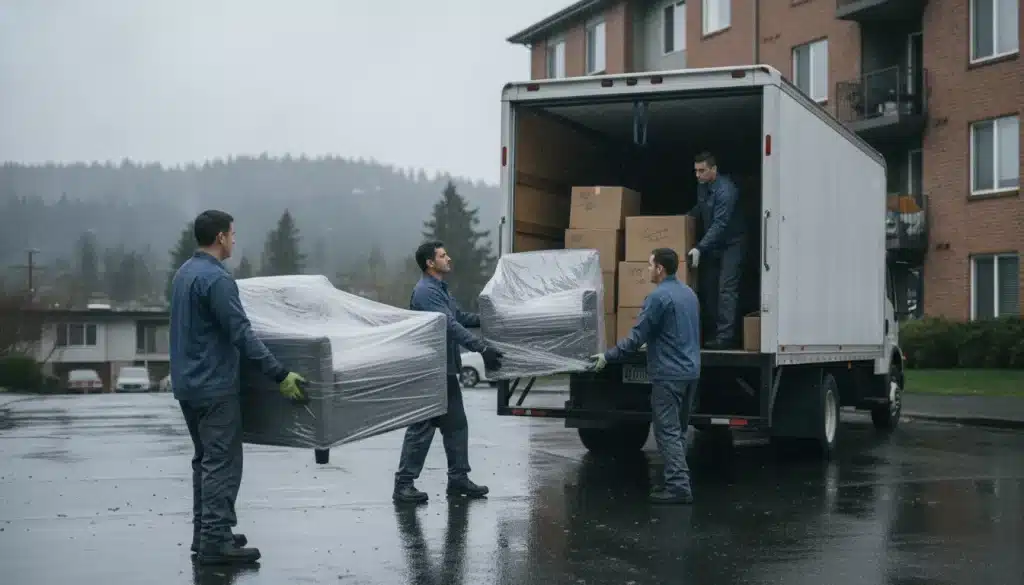
A move inside the Puget Sound region is rarely a straight drive across town. Water, bridges, and building rules sit between Seattle, Tacoma, Bellevue, and the islands. Households and businesses both lose time when a truck reaches a ferry line, a toll plaza, or a locked loading dock without a plan. Puget Sound movers who know the region treat those limits as part of the job, not as surprises on moving day.
Request a detailed Puget Sound moving estimate
This guide covers how to plan a move across the region. It walks through ferry and bridge choices, building access, timing, and short-term storage. City service lists stay on the Seattle movers and Tacoma movers pages. Use those pages for local crews. Use this one to connect the two sides of the water.
What Puget Sound Movers Plan Before the Truck Rolls
Start with the route, not the box count. A Seattle apartment to a Tacoma house can use I-5, or it can depend on a ferry if the new home is on Bainbridge, Vashon, or the Kitsap side. An office move from Bellevue to Seattle may cross the SR 520 bridge twice in one day if the crew has to stage a second load. Write the origin, the destination, and every stop in between before you ask for a price.
Good regional planning answers five questions:
- Will the truck stay on highways, or does any leg require a ferry?
- Which bridges charge a toll, and in which direction?
- What elevator, dock, or stair rules apply at both buildings?
- Does the new place open on the same day the old place must be empty?
- If those dates do not match, where will the goods sit?
Transit Moving Systems handles residential and commercial moves in Seattle and Tacoma, plus packing, storage, and specialized items such as pianos, art, and antiques. A detailed estimate needs the route and the access notes. A bedroom count alone cannot price a ferry hold or a freight elevator that only runs before 8 a.m.
Ferry Rules That Change a Moving Day
Washington State Ferries does not treat every route the same. Vehicle reservations are available only on the Anacortes/San Juan Islands route and the Port Townsend/Coupeville route. Other routes, including the busy Seattle-side runs, do not take vehicle reservations. A moving truck on those sailings waits in the regular vehicle line.
On the two reservation routes, a reservation holds a vehicle space. It is not a ticket. You still buy the fare at the terminal or online. Reservations are one-way, so a round trip needs two bookings. WSDOT asks drivers to arrive 30 to 45 minutes early at Port Townsend/Coupeville and 45 to 60 minutes early at Anacortes. Miss the check-in and the space can be treated as a no-show.
Commercial and oversized vehicles face extra limits. WSDOT requires an Oversized/Overweight Vehicle Travel Request in four cases. File it when a vehicle is over 80,000 pounds gross, wider than 8 feet 6 inches, taller than 13 feet 4 inches, or lower than 14 inches of ground clearance. Allow up to two business days for that request. Vessel deck height also changes by boat, so a truck that fits one ferry may not fit the next sailing. Fares are based on vehicle length, and a vehicle wider than 8 feet 6 inches is charged double the length-based fare.
Island and peninsula moves need a different calendar than a city-to-city move. Build the sailing into the start time. Do not assume a truck can “catch the next boat” with a full load and still meet a building’s elevator window.
Bridge Tolls and the Land Route
Many Puget Sound moves never touch a ferry. They still meet tolls. Two crossings matter most for household and office moves.
The SR 16 Tacoma Narrows Bridge collects a toll only for trips headed toward Tacoma. Rates are fixed all day. As published by WSDOT, a two-axle vehicle pays $4.50 with a Good To Go! pass, $5.50 at the toll booth, or $6.50 by mail. A moving truck with more axles pays more. A three-axle vehicle is $6.75 with a pass. A six-axle vehicle is $13.50 with a pass. Pay By Mail adds $2 to the pass rate. The crew should know this before a Gig Harbor or Kitsap move into Tacoma, because the toll is part of the route, not an optional extra.
The SR 520 bridge between Seattle and the Eastside is tolled in both directions. WSDOT uses variable rates by axles and time of day, with a lower Good To Go! pass rate and a higher Pay By Mail rate. There is no cash booth. A Bellevue-to-Seattle move that crosses 520 during a peak window costs more than the same crossing at midday. The I-90 floating bridge is the untolled alternative when the schedule can absorb the extra miles.
| Crossing | When you pay | What to plan |
|---|---|---|
| Tacoma Narrows (SR 16) | Only toward Tacoma | Fixed rate by axle count. A pass is cheaper than the booth or a mailed bill. |
| SR 520 bridge | Both directions | Rate changes by time of day and axles. No cash booth. Good To Go! is the lowest rate. |
| I-90 floating bridge | No toll | Use it when a peak 520 toll or a delay would break the elevator window. |
| Reservation ferries | Ticket plus a reserved space | San Juan Islands and Port Townsend/Coupeville only. Book each direction. |
| Other WSF routes | Ticket only, no reservation | The truck waits in line. Leave slack for a missed sailing. |
Toll accounts and ferry tickets are operating details. They do not replace a written moving estimate. Tell the estimator which bridge or boat the move will use so the drive time is real.
Building Access on Both Ends
Regional distance is only half the job. The other half is the building. Seattle streets in Queen Anne and Capitol Hill are steep and tight, and rain changes how crews cover furniture. Downtown and South Lake Union towers often require a certificate of insurance, a reserved freight elevator, and a loading dock booked days ahead. Tacoma houses may add a long carry from the curb, a steep driveway, or a ferry-timed arrival that cannot slip by an hour.
Collect the same facts at both addresses:
- Floor number, elevator size, and the hours the freight elevator is open.
- Dock height, parking distance, and any stair or long-carry path.
- Certificate-of-insurance wording the property manager requires.
- Items that need extra handling, such as a piano, artwork, or a large appliance.
- Whether the building allows weekend or evening moves.
Commercial moves add one more constraint. Office buildings often limit elevator use to before 8 a.m. or after 6 p.m. so tenants are not blocked. A crew that can finish a house at noon may need a night window for an office. Share that limit when you request the estimate. Transit can coordinate packing and IT-related setup with the move, but the building’s rules still set the clock.
Timing a Move Across the Region
Weekday mornings on I-5 between Seattle and Tacoma are slow in both peaks. A truck that leaves Seattle at 7:30 a.m. can spend the elevator window sitting in traffic. Leaving after 9:30 a.m., or starting the load the evening before when the building allows it, is often faster than a dawn departure.
Match the clock to the route:
- Confirm the old building’s load-out window and the new building’s load-in window.
- Add drive time that includes a toll crossing or a ferry wait, not a maps estimate at midnight.
- Add 30 to 60 minutes if a reservation ferry is involved, so check-in is not rushed.
- Hold a second day if the two buildings’ windows cannot overlap.
- Book storage if the new keys arrive after the old lease ends.
Summer weekends and Seahawks or Mariners game days tighten downtown access. Island sailings fill earlier on Fridays. None of these are reasons to guess a price. They are reasons to put the date and the neighborhood in the estimate request.
When Storage Belongs in the Plan
Keys rarely line up. A Tacoma house may close a week after a Seattle lease ends. An office may open a floor before the furniture can move. Storage in transit covers that gap. Transit Moving Systems offers pickup, secure holding, and delivery when the new place is ready, including climate-controlled storage for items that should not sit in a truck or a garage.
Use storage when:
- The move-out date and move-in date are different.
- A remodel, paint, or floor job needs an empty room.
- A ferry or building window cannot take the full load in one day.
- A business wants desks delivered in stages rather than all at once.
Say what must stay climate-controlled, how long you expect to store it, and whether you need a partial delivery. The moving and storage services overview explains how a combined move and hold works. Do not treat a storage blog as a rate card. The estimate still depends on volume, access, and time.
What to Send for a Detailed Estimate
A useful estimate lists the work. Send the origin and destination cities, the move date, stairs or elevator limits, and any ferry or bridge the truck must use. Add photos of tight turns, long carries, and specialty pieces. For an office, include the after-hours rule and a floor plan if you have one.
Transit Moving Systems publishes market phone lines on its contact page. Tacoma and the Washington service area use (206) 333-2905. The company also lists (346) 646-7955 for Houston and (720) 704-8450 for Denver. For a Puget Sound move, start with the Washington line or the contact form, and name both cities in the request. Seattle does not have a separate street address on that page. Treat Seattle as a service area covered from the Washington operation, and let the estimator confirm crew and truck assignment.
Ask for the scope in writing. A clear estimate states what is packed, what is moved, whether storage is included, and which access limits were assumed. If a ferry reservation or an oversized-vehicle approval is required, that step should be named before moving day. WSDOT publishes the current ferry reservation rules and the Tacoma Narrows Bridge tolls. Check those pages when a route uses a boat or a toll bridge. A move that stays inside Washington is still easier to manage with the same written scope.
See Washington moving services and send your route, dates, and access notes for a detailed estimate.
Frequently Asked Questions
Do Puget Sound movers need a ferry reservation for every island move?
No. Washington State Ferries offers vehicle reservations only on the Anacortes/San Juan Islands route and the Port Townsend/Coupeville route. Other routes load vehicles without a reservation, so the truck waits in line. A reservation is also not a ticket. You still pay the fare, and you should book each direction.
Which bridges charge a toll on a Seattle or Tacoma move?
The Tacoma Narrows Bridge tolls only trips headed toward Tacoma, at a fixed rate based on axles. The SR 520 bridge tolls both directions, and the rate changes by time of day. I-90 is the untolled crossing between Seattle and the Eastside. Tell your mover which one the route uses.
Can one crew move a home from Seattle to Tacoma in a single day?
Often yes, when both buildings allow a midday or full-day window and the load fits one truck. It slips to two days when freight elevators are limited to early morning, the carry is long, or the new keys are not ready. Storage covers a gap between lease dates.
What should a business include in an office move request?
Include both addresses, the after-hours elevator window, dock rules, a certificate-of-insurance request, and whether IT equipment moves with the furniture. A regional office move fails when the building window is shorter than the drive. Put that window in the first message, not the morning of the move.
How do I request a detailed estimate?
Use the contact form or call the Washington line at (206) 333-2905. List the cities, the date, stairs or elevators, specialty items, and any ferry or toll bridge. You will get a scope based on those facts rather than a generic bedroom price.